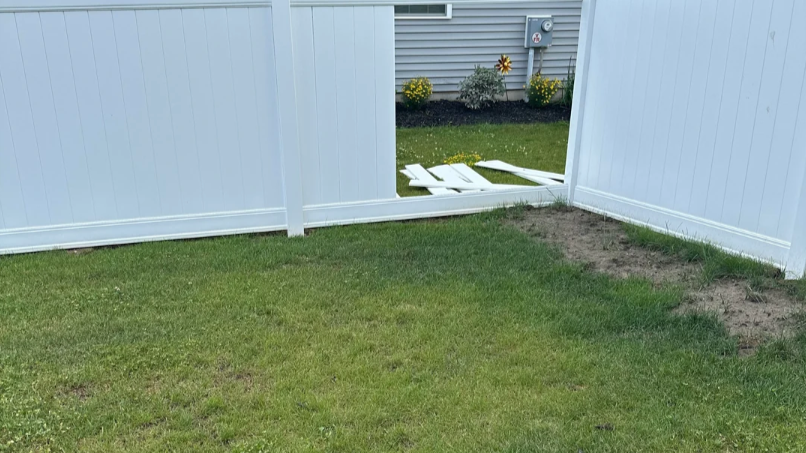
A resident was injured when a neighbor’s dog escaped through a collapsed section of a vinyl privacy fence. The matter ultimately resulted in a $1.025 million settlement, as reported in the original LinkedIn article. For the engineering investigation, the critical question was why the fence failed and whether its construction contributed to the incident.
HUB Engineering, with Principal Engineer Himad Beg, P.E., was retained by the plaintiff’s attorney to conduct a forensic investigation and determine the cause of the fence’s failure. Our analysis concluded that the fence, which had previously been relocated by a contractor, contained multiple construction defects that contributed to an unstable condition.
Key Findings From the Engineering Investigation
- Insufficient concrete footings: Our investigation found inadequate concrete embedment at the fence posts. In our engineering opinion, this contributed to excessive movement and instability.
- Unsecured rails and panels: Our inspection revealed an absence of fasteners or screws securing the fence’s top rails inside the posts. The analysis identified a mechanism by which movement from wind could allow the rails to pull out and a panel to collapse. Properly securing the rails was an important part of the installation evaluated in this case.
- Improper installation: We observed that fence posts were not installed plumb, or vertically straight. This, combined with scuff marks indicating excessive movement, supported the finding of improper installation.
The original article referenced ASTM F1999-14, Standard Practice for Installation of Rigid Poly(Vinyl Chloride) (PVC) Fence Systems. Its published scope addresses areas where maximum frost penetration does not exceed 30 inches and directs users to consider the specific manufacturer’s instructions and applicable code requirements. Installation criteria must therefore be evaluated for the particular fence, location, and use, rather than reduced to a universal footing-depth rule.
How Wind Interacted With the Construction Defects
The weather information considered in our investigation reported wind gusts of up to 47 mph in the area on the day before and the morning of the incident. The dog’s owner stated that a fence panel had fallen off the night before due to the heavy wind.
Our engineering opinion was that these winds acted on the pre-existing construction defects and caused the fence’s failure, allowing the dog to escape. The analysis connected the observed physical deficiencies, evidence of movement, weather conditions, and reported sequence of events.
This preserves an important distinction for an engineering investigation: identifying wind as a load on a structure does not, by itself, explain why that structure failed. The condition of the posts, their support, and the rail-to-post connections also matter.
What the Case Shows
This case illustrates the importance of proper construction and how a forensic investigation can explain the physical mechanism of a failure. For attorneys handling premises-liability matters, the engineering contribution is a supported analysis of the condition, its response to the forces acting on it, and its relationship to the reported incident. Legal determinations of negligence and proximate cause remain separate from that engineering analysis.
The reported settlement is an outcome of this particular matter, not a prediction for another case. Settlement values depend on many considerations beyond the engineering issues.
How HUB Engineering Can Help Evaluate Your Case
For a matter involving premises liability, construction defects, or personal injury, a rigorous engineering investigation can help clarify the technical issues. HUB Engineering provides objective forensic engineering and expert witness services, translating physical evidence into clear reports and testimony.
Led by Himad Beg, P.E., a Board Certified Diplomate in Forensic Engineering, the practice has experience in:
- Slips, trips, and falls
- Construction accidents and OSHA-related investigations
- Walkway audits
- Building code compliance and property maintenance
Contact HUB Engineering for a confidential consultation to discuss the technical merits of your case.
References
- Original LinkedIn article Himad Beg, P.E.; original publication and case narrative source.
- ASTM F1999-14: official abstract and scope Public scope only; not a review of the complete standard or confirmation of site-specific applicability.