Two premises-liability cases had the same surface-level description: a pedestrian slipped and fell on ice. That is where the similarity ended.
According to retaining counsel, the forensic engineering reports prepared by HUB Engineering helped resolve one matter for $735,000 and another for $650,000.
The combined $1.385 million in settlements is certainly significant. But from an engineering standpoint, the more important lesson is why these cases required substantially more analysis than simply establishing that ice was present.
In a snow-and-ice case, “there was ice” is only the beginning.
Where did the ice come from? How long had it been there? Were the conditions that produced it foreseeable? Was there sufficient opportunity to inspect and remediate the condition? Did drainage, site geometry, maintenance practices, or other property conditions contribute to its formation? And were applicable safety requirements followed?
Those are questions that forensic engineering can help answer.
Case One: How the Ice Formed
The first matter involved a nighttime slip and fall at the top landing of an exterior stairway serving a multi-family residential property.
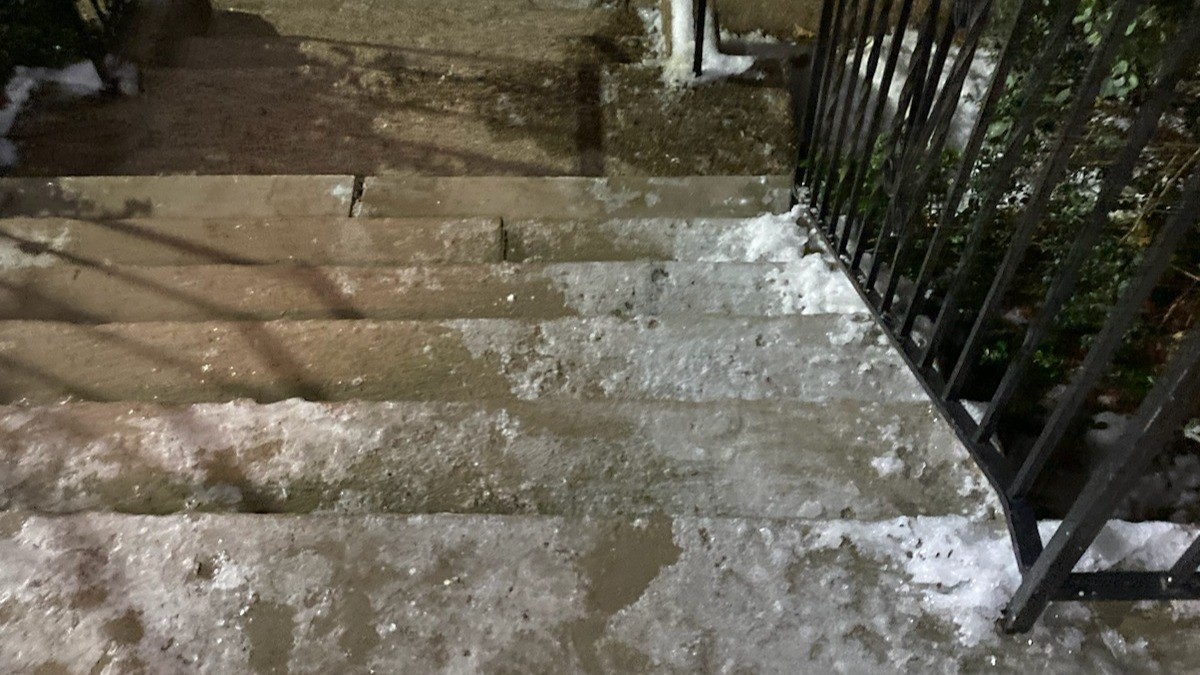
A photograph taken around the time of the incident documented ice on the landing and stairs. Our site inspection also documented conditions relevant to how the ice could have formed.
Directly above the incident area was a deteriorated gutter system exhibiting joint separation, staining, and other physical evidence consistent with recurring leakage. Measurements also established that the landing was nearly flat, with a slight slope directing water toward the leading edge of the landing and the stairs below.
The weather history added another critical piece of the puzzle. The last significant snowfall had ended more than two days before the incident. On the incident day, temperatures rose above freezing before falling below freezing again during the evening.
When those facts were evaluated together, a coherent physical mechanism emerged: water from melting snow and the deteriorated drainage system could reach the landing, migrate toward the stairway, and subsequently refreeze in the pedestrian path as temperatures dropped.
The engineering analysis therefore did not simply conclude that the pedestrian encountered ice. It connected the weather history, drainage condition, site geometry, photographic evidence, maintenance condition, and applicable safety requirements to support the opinion that the hazard was foreseeable and preventable.
The report also evaluated requirements governing the maintenance of common areas, exterior walking surfaces, means of egress, drainage systems, and snow-and-ice control. The result was a technically supported explanation of the hazard and its causal relationship to the incident.
According to retaining counsel, that matter ultimately settled for $735,000.
Case Two: Establishing the Timeline of an Untreated Icy Sidewalk
The second matter involved a pedestrian who slipped on an icy public sidewalk adjoining a commercial property. Here, the engineering challenge was different.
A detailed forensic weather analysis established that freezing rain, freezing drizzle, and sleet had accumulated during the overnight and morning hours. By the time of the afternoon incident, precipitation had stopped, but approximately 0.6 inch of ice cover was estimated to remain on untreated and exposed exterior surfaces. That estimate concerns untreated, exposed exterior surfaces; establishing conditions at a particular location also requires the site and incident evidence.
The incident record further indicated that the sidewalk had not yet been salted.
Our inspection documented the physical configuration of the sidewalk and the location of the fall immediately adjacent to the commercial premises. The investigation also identified the absence of warning signs, cones, barricades, or other measures alerting pedestrians to the icy condition.
The significance of the weather timeline was substantial. Instead of characterizing the event simply as a fall occurring “during bad weather,” the evidence allowed the condition to be evaluated in terms of when the ice accumulated, when the precipitation ended, how long the hazardous condition remained, and what opportunity existed to inspect and address it before the pedestrian encountered it.
Applicable municipal requirements and nationally recognized snow-and-ice safety standards were then evaluated against those circumstances, including requirements and practices involving inspection, deicing, salting or sanding, monitoring, and warnings.
The engineering evidence supported the conclusion that the hazardous icy condition had not been adequately remediated before the incident.
According to retaining counsel, that matter ultimately settled for $650,000.
What Forensic Engineering Added to Both Cases
Neither investigation depended on simply saying that ice is slippery. That would add little to a premises-liability case.
The value of the engineering analysis was in taking multiple pieces of evidence that might otherwise appear unrelated, including photographs, measurements, weather data, drainage conditions, maintenance practices, incident documentation, codes, regulations, and nationally recognized safety standards, and determining whether they formed a scientifically and technically supportable explanation of the incident.
In one case, the evidence pointed toward a melt-refreeze condition compounded by deficient drainage maintenance. In the other, the evidence established an untreated ice condition remaining after a documented freezing-rain event.
Different properties, mechanisms, and evidence led to the same fundamental forensic question: did the physical evidence demonstrate the existence of an unsafe condition that reasonably should have been identified, corrected, treated, or otherwise addressed before someone was injured?
The Key Takeaway
Winter weather does not automatically explain a slip-and-fall incident.
Ice can result from active precipitation, melting snow, refreezing, roof drainage, improperly located snow piles, inadequate removal, insufficient deicing, poor maintenance, or a combination of several factors. Determining which mechanism actually occurred requires investigation.
That distinction can be important in litigation because a strong forensic engineering opinion should do more than identify a hazard. It should explain the physical mechanism, foreseeability, applicable safety requirements, and causal relationship between the condition and the incident.
At HUB Engineering, PLLC, our role is to follow the evidence. We conduct site inspections, document and measure physical conditions, analyze photographs and video, evaluate weather and incident records, research applicable codes and nationally recognized standards, and determine whether the available evidence supports engineering opinions within a reasonable degree of engineering probability.
According to retaining counsel, that analysis helped bring these two matters to resolutions totaling $1.385 million.
Every matter turns on its own facts, and settlement values depend on many considerations beyond the engineering issues. These cases illustrate the value that a thorough, evidence-based forensic engineering investigation can bring to premises-liability litigation.
If you are handling a matter involving a slip or trip and fall, snow or ice, sidewalks, stairways, drainage, walking surfaces, property maintenance, or another potentially hazardous physical condition, HUB Engineering can help determine what the physical evidence actually shows.
References
- Original LinkedIn article Himad Beg, P.E.; original publication and case narrative source.