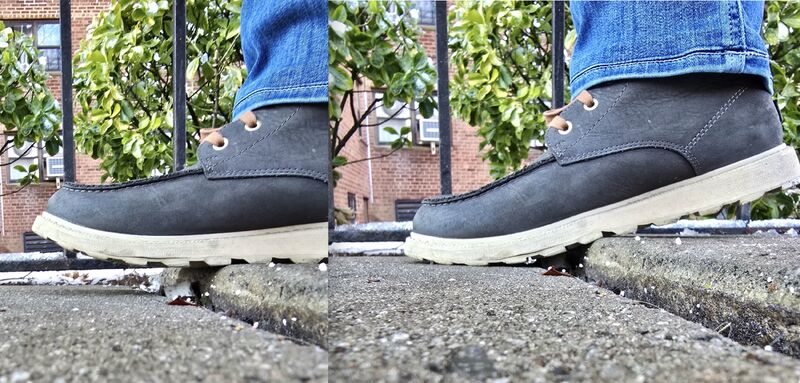
Not every sidewalk fall involving an elevation difference is a traditional “trip.” Sometimes the mechanism is a misstep.
A prior anonymized forensic investigation illustrates the distinction. The pedestrian was walking across a sidewalk joint from the higher concrete slab toward the lower slab. The joint contained a measurable vertical differential together with a deteriorated void between the adjacent walking surfaces.
From that direction of travel, the mechanism was different from the classic scenario in which the toe strikes the face of a raised slab. Instead, as the advancing foot transitioned onto the lower and irregular surface, it could fail to obtain stable, level support. The combination of the elevation change and adjacent void can allow the foot to land unevenly or roll forward, resulting in a misstep and loss of balance.
That distinction matters in forensic engineering. The same sidewalk defect can interact with a pedestrian differently depending on which direction the person is walking and where the foot lands.
The engineering report specifically recognized that a raised edge can produce a trip-type gait interruption, while an elevation change combined with a depression or void can result in a misstep, forward rolling motion of the foot, and loss of balance.
For attorneys evaluating sidewalk cases, the analysis should therefore go beyond: “How high was the sidewalk differential?” Also ask:
- Which direction was the pedestrian traveling?
- Was the person approaching the raised side or the depressed side?
- Where was the advancing foot expected to land?
- Was there an adjacent void or deteriorated joint?
- Was the elevation change readily apparent from the pedestrian’s approach?
- Does the reported body movement fit a trip, misstep, or loss-of-support mechanism?
The report also documented that, from the pedestrian’s approach, the depression and uneven joint were not readily apparent and blended into the surrounding concrete surface.
At HUB Engineering, we evaluate not only how much a walking surface is displaced, but how the pedestrian actually encountered that geometry.
References
- Original LinkedIn post Himad Beg, P.E.; original publication and case narrative source.